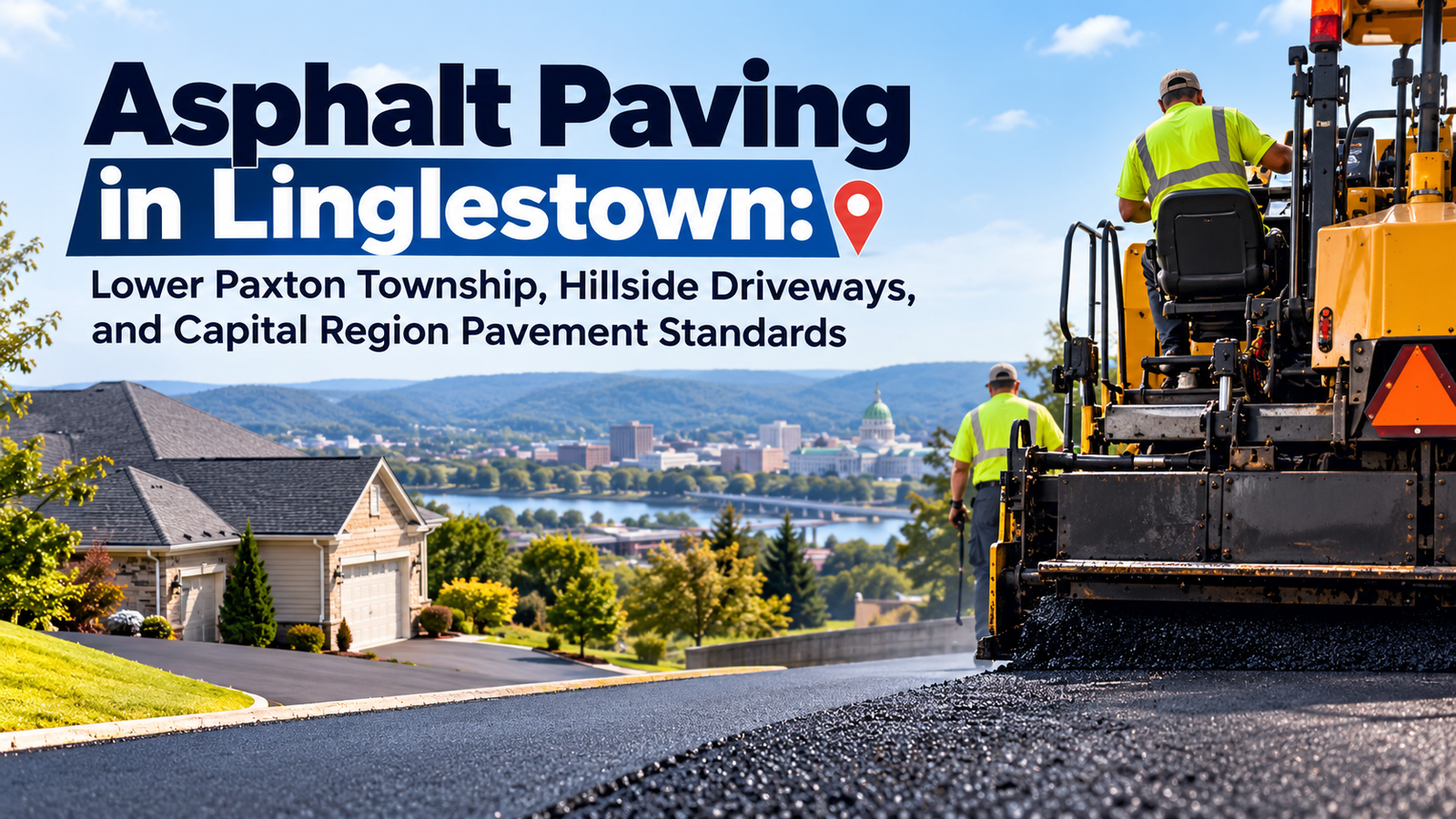
Linglestown is a community within Lower Paxton Township in Dauphin County, located along the Route 22/322 corridor northeast of the City of Harrisburg. The area represents the middle and outer ring of the Harrisburg Capital Region a suburban zone of residential subdivisions ranging from mid-century ranch and split-level homes on modest lots to newer construction in larger-lot developments in the township’s hillier eastern sections. Commercial development along the Route 22 corridor adds a significant parking lot and access drive component to the area’s pavement inventory.
Asphalt Contractor Linglestown pavement conditions are shaped by the same central Pennsylvania climate that affects all of the Capital Region, but the topography here introduces elements not present in the flat inner-ring neighborhoods closer to Harrisburg: hillside driveways with significant grade changes, surface drainage patterns that must manage water running downhill rather than simply standing on flat terrain, and residential subdivisions with mix of lot types that create a range of pavement installation challenges.
Topography and Drainage in Lower Paxton Township’s Hillier Sections
The eastern portions of Lower Paxton Township rise into the dissected plateau region of the Dauphin County hills, where residential development occupies slopes of five to fifteen percent and some driveways approach grades of twenty percent on the steeper access drives in wooded subdivisions. This topography creates pavement conditions that differ fundamentally from the flat terrain of inner-ring communities.
On sloped driveways, water runs along the surface rather than ponding. This is generally beneficial for pavement longevity standing water is a primary driver of freeze-thaw infiltration but surface drainage must be managed so that runoff does not channel down the driveway centerline and concentrate at the street connection, where it can undermine the apron and contribute to gutter erosion on the adjacent road.
Driveway drainage is designed with cross-slopes, drainage swales at the edges, and in some cases trench drains across the driveway width at the garage approach to intercept water before it enters the garage or building foundation area. On long driveways with multiple grade transitions, drainage structures at grade break points prevent the concentration of runoff that leads to erosion and edge raveling.
Frost Heave and Deep Aggregate Base Requirements on Sloped Sites
Frost heave is a greater concern on sloped sites in Lower Paxton Township than on flat terrain for two reasons. First, cold air drainage on hillsides concentrates colder temperatures at low points, which can push frost penetration deeper than average in hollow or valley positions. Second, sloped surfaces intercept more water from upslope drainage, keeping soil moisture higher than in well-drained flat terrain, and wet soils are more susceptible to frost heave than dry ones.
Professional asphalt installation on sloped sites in Linglestown accounts for these factors with base designs that place the frost penetration depth above the critical subgrade. Dense-graded aggregate base of six to eight inches is typical for residential driveways in hillier locations. On steeper slopes, the base may include geotextile separation layers to prevent fine-grained subgrade soils from migrating up into the aggregate under repeated freeze-thaw loading.
Compaction of the aggregate base on sloped sites requires attention to equipment positioning to ensure uniform compaction across the full width of the driveway. Vibratory roller compaction on steep grades requires operator experience to achieve consistent density without allowing the roller to shift.
Route 22 Commercial Corridor: Parking Lot and Access Drive Paving
The Route 22/322 corridor through Linglestown carries significant commercial traffic serving the northeastern Harrisburg suburbs. Strip shopping centers, medical facilities, auto service businesses, and fast food and restaurant uses along this corridor all generate large paved parking areas and access drives that must handle both passenger vehicles and delivery traffic.
Commercial pavement design in this corridor is based on traffic loading analysis. The design pavement section specifying base thickness and asphalt lift thickness is calibrated to the expected load repetitions from delivery trucks, bus traffic, and concentrated passenger vehicle movements at entry and exit points. Turning movements at access drives create concentrated wheel loads that accelerate edge cracking and surface raveling if the pavement design does not account for them.
Parking lot maintenance in the Route 22 corridor must address the effects of heavy vehicle overloading delivery trucks that exceed the design load in designated parking areas. Wheel stops and clear signage can direct heavy vehicles to areas of the lot designed for that traffic, but a maintenance program that includes periodic crack sealing and sealcoating is essential for extending the service life of commercial pavement in high-traffic commercial settings.
Residential Subdivision Driveways in Linglestown’s Newer Development Areas
Newer residential subdivisions in the Linglestown area include developments constructed in the 1990s through the 2010s on the hillier terrain east of the Route 22 corridor. Many of these properties feature longer driveways 60 to 150 feet in some cases that traverse significant grade changes and serve large attached garages.
Asphalt driveways in these newer subdivisions are now at the age where the first major maintenance cycle is either overdue or actively needed. Original installations from the late 1990s and early 2000s that have received only intermittent sealcoating without crack repair may show surface oxidation, transverse cracking from thermal cycling, and edge cracking from root intrusion or base migration at the driveway margins.
Assessment of these driveways must determine whether the existing pavement is a candidate for overlay milling the top inch and replacing with new surface course or whether deterioration has progressed to the point where base failure requires full-depth replacement. An experienced paving contractor can distinguish between surface distress that an overlay will address and structural failure that requires a more complete solution.
Winter Performance and Sealcoating Timing in Lower Paxton Township
The suburban setting of Linglestown means that snow removal is handled by PennDOT on Route 22 and by the township on local roads, but private driveways are the homeowner’s responsibility. Snow plowing and snow blower use on unsealed or deteriorated asphalt can accelerate surface raveling, particularly on driveways with existing surface cracks where plow blades catch and widen crack edges.
Sealcoating before winter closes the surface and reduces the entry points for snow melt and ice melt water. Spring and early fall are the preferred seasons for sealcoating in Lower Paxton Township, with fall application providing the advantage of protecting the surface through the winter months immediately following treatment. Fall applications should be completed before sustained temperatures drop below 50 degrees Fahrenheit, typically by early to mid-October in the Harrisburg area.
Hot-pour crack sealing should be completed before sealcoating, as noted throughout the Harrisburg Capital Region paving discussion. Cracks that are sealed with flexible rubberized sealant accommodate the thermal cycling that opens and closes crack widths with temperature changes, maintaining the seal through multiple winters without requiring re-treatment at the frequency that rigid fillers would demand.
Frequently Asked Questions: Asphalt Paving in Linglestown, PA
How does a sloped driveway affect drainage design?
Sloped driveways require cross-slopes, edge swales, and sometimes trench drains at grade transitions to manage runoff and prevent water from concentrating at the street apron or garage approach.
Why is base thickness important on hillside driveways in Lower Paxton Township?
Cold air drainage concentrates frost penetration in valley positions, and upslope water keeps subgrade moisture elevated. Deeper aggregate base keeps frost above the critical subgrade and uses geotextile separation layers to prevent fine-grain soil migration.
What maintenance do Route 22 commercial parking lots need?
Crack sealing, sealcoating on a three-to-four-year cycle, and monitoring of high-stress areas at turning movements and access drive entries. Heavy delivery vehicle loads should be directed to areas designed for that traffic.
When is an overlay appropriate versus full-depth replacement?
Overlay is appropriate when surface distress is present but the base structure remains sound. Full-depth replacement is required when base failure evidenced by alligator cracking, significant rutting, or subgrade saturation is present.
When should sealcoating be applied in the Harrisburg area?
Spring and early fall, when temperatures are consistently above 50 degrees Fahrenheit. Fall application protects the surface through winter. Crack sealing must be completed before sealcoating begins.
Asphalt paving in Linglestown and the broader Lower Paxton Township area rewards contractors and property owners who understand the interplay between topography, climate, and pavement design. The hillier terrain east of Route 22, the commercial intensity of the corridor itself, and the aging residential subdivision stock all present specific challenges that well-planned installation and consistent maintenance programs address effectively.